A golden rule in reading engine specification - do not totally mesmerized by the high horsepower and torque figure! A bike which has bigger horsepower and torque at the same CC, does not mean it is better in overall performance. The most important aspect of an engine is a smooth power output from low to high rpm, where you can feel the torque from low to mid, and some good power at high rpm. You can cruise, and you can run! However, the problem of standard 135LC is, we can cruise, but we can't run away too far. Goshh.
Nevermind, put that aside first. Let's move on......
How do we know the power output characteristic of an engine? Read the power curve in dyno chart.
Below is the dyno chart extracted from B.R.T. website. It described power curve of standard 135LC engine, before and after installing its product.
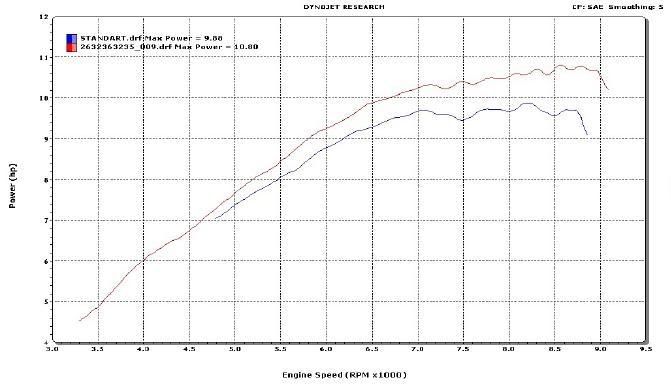
The blue color curve is standard setting. See? The power goes up smoothly up to 7k rpm only (mid-high range). At high rpm, the power not only sux, but unstable. It goes up a bit, then go down again, up again and down again. The feel on our buttock will be like, wanna go ... dowan to go... wanna go.... dowan to go. It is really shit, especially we want to play top speed with people on straight road, or accelerating up a steep hill.
After changing the CDI, the ripple effect at high rpm is still there. Although power figure increased slightly, you will still feel the stupid wanna go... dowan go... wanna go ... dowan go feeling.
This problem usually is caused by bad airflow from exhaust system at high rpm. As you know, we have some rules and regulations on exhaust gas emission. Manufacturers have to comply to these, so they have no choice but to seal the best part!
Don't worry, I already know how to break this seal and will share out in upcoming articles.
Stay tuned !

really good la bro...
ReplyDeletei really cant wait for ur next post...
hurry..hurry...